Beyond Linear Models: Why Nonlinear Modelling Is Essential
Small as well as large production units
benefit from nonlinear models
Choosing the right modelling approach is crucial. Here is why nonlinear modelling often provides a superior alternative to
traditional physical or linear empirical methods.

The Limits of Physical Models
While foundational, physical modelling has practical constraints:
- Limited Applicability: Many real-world systems are too complex for purely physical models.
- High Cost & Time: Development is often expensive and time-consuming.
- Inherent Simplification: They rely on assumptions that can reduce real-world accuracy.
- Computational Speed: They are usually slower than efficient empirical or semi-empirical models at computing outputs.
The Shortcoming of Linear Empirical Models
Small as well as large production units
benefit from nonlinear models
When physical modelling isn't feasible, empirical modelling is the go-to alternative. However, traditional
methods rely on linear statistics, and nothing in nature is perfectly linear.
- While linear approximations can work for small variable ranges, they often fail to capture the true behavior of complex systems.
- A common suggestion is to add quadratic terms to linear regression. This is not only inefficient but still highly restrictive.
Nature isn't merely quadratic either. We shouldn't force its complexity into overly simplistic forms.
The Power of Modern Nonlinear Modelling
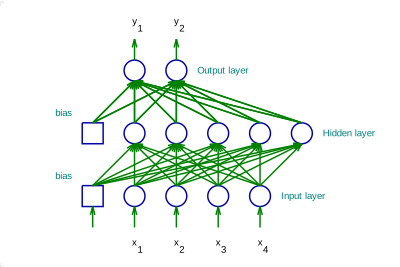
Modern nonlinear techniques including artificial neural networks offer a powerful solution. They allow us to model "free-form"
nonlinearities without having to predefine their exact mathematical form.
- Instead of ignoring nonlinearities or trying to specify them in detail, these advanced methods learn the patterns directly
from the data.
- This results in more accurate, efficient, and generalisable models that reflect the nuanced behavior of natural
as well as engineered systems.